
“I believe my generation’s counterculture and alternative music reflected the painful birth canal into the 21st-century. Through the fire we went, and now we are all going through forevermore. Gen X and Gen Z have a lot to do and learn together.”
Melissa Auf der Maur
Music, memory and meaning.
Interview by Emily Waller.
Our Book of the Year for 2026, Even the Good Girls Will Cry: My ’90s Rock Memoir, is more than a backstage account of an iconic decade. It's a deeply personal reflection on family, identity, creativity and the people and places that shape us. Melissa Auf der Maur's (Hole, The Smashing Pumpkins) story reminds us why these experiences are worth documenting, sharing and passing on.
Emily caught up with Melissa to discuss creative legacy, women in music, the emotional power of art and what it means to preserve our memories in an increasingly digital world.
Hi Melissa! We're so thrilled to celebrate your incredible memoir as our Book of the Year for 2026. Thank you for taking the time to answer a few questions and for sharing such a personal chapter of your life and creative journey with us.
You've spoken with great admiration about your parents, particularly your mother and the strength of will she instilled in you. How has that influence shaped the person and artist you've become?
I am very grateful that both my parents provided remarkable examples and role models of how to build one’s life around passion, honesty and risk taking. I credit them (and Montreal, the fine city they raised me in and devoted themselves to) for having enabled me to make a remarkable adventure out of my life.
My mother taught me to not conform to any traditional roles society had locked in for women. Fortunately, for everyone, the turn of the millennium, in the “free world” the new generations are continuing to follow suit. But I credit my mother‘s generation of second wave feminism that really broke away from housewife aspirations and our ability to hold a housing mortgage and our own credit card (!!!), and reproductive rights. We must continue and never take our freedoms for granted. In fact, the USA women’s rights are going backwards. So my mother’s and my generation’s story are as important as ever to inspire momentum and continuous progress.
As for me, as an artist - I was raised to be a woman who truly believes that art and women can lead the way to the most liveable, sustainable, resilient future. I’ve lived my life by that and it’s proven to deliver beautifully - and I am committed to passing that on!
As you reflect on your own legacy, how important do you feel the passing of knowledge, experience and creative spirit is between generations?
I feel every generation has a responsibility to make the world a better place and pass on to future generations what they’ve learned and witnessed during their time, especially during their visceral coming of age. As I stated in my memoir, I never would’ve picked another decade to come into my womanhood. The turn of the millennium only happens in few generations and the extreme transition we experienced between the analog-to-digital, the old world to the still being unveiled future world (which has certain shades of doom between environmental decay and predatory capitalism), was a remarkable time to find one’s voice and purpose in life. With these memoir and archive projects, I am driven to hand in my report for the young people coming into themselves right now. The world is changing so quickly, but the millennium really did turn up the speed of technological advances and political and environmental threats. I believe my generation’s counterculture and alternative music reflected the painful birth canal into the 21st-century. Through the fire we went, and now we are all going through forevermore. Gen X and Gen Z have a lot to do and learn together.
You were at the heart of a remarkable period for alternative rock, when women challenged expectations and carved out space on their own terms. Looking at the music landscape in 2026, how do you view the evolution of women’s representation, creative freedom and influence?
Let’s start with Olivia, Billie (and a precursor splash of Taylor) — women are the mainstream musical landscape. Considering that in 1994, my commitment to join Hole was underscored by my commitment to bring women onto a male dominated landscape of rock music. Rock was the mainstream music at the time, starting with Nirvana and the rest of them. By the end of the 90s Hole had achieved much that we had aspired to: the cover of every magazine, top 40 hit songs, but strangely we were the only women on the festival bills alongside the strangest men, including Marilyn Manson, Limp Bizkit, and Korn. We stepped away slowly from the scene, but woke up to a new world a couple decades later to see the women take over. It brings me great joy and satisfaction, watching these young women step into their power and lead the mainstream with feminine themes and empowerment.
That being said, that is only in the world of MUSIC, which is something for people who are devoted to music, and people around the world who are lucky enough to have MUSIC listening devices. But we must not be fooled, women’s rights are at stake globally. Including in the US with a dark turn of neoconservatism threatening women’s reproductive rights. Globally, violence against women continues to be on high, even in the progressive “free” world. And a full-blown tragedy and disaster in most underdeveloped countries, where women’s bodies are controlled, married off and mutilated. True crisis globally at all times when it comes to women and girls!
So as much as I am hopeful and grateful for the progress in the world of music, I continue to believe that we must continue to fight to protect women and girls as a counterbalance to this predatory capitalism and male-dominated power structure.
Side note regarding powerful women in music: Olivia Rodrigo, a 23 year-old girl with her festival Daisy Chain Fields, raised $20 million and major awareness to protect women and girls in America. That’s nothing to scoff at – the first major use of her platform and that is change and girl power at its best!
Your creative life has always extended beyond music; photography, in particular, plays a significant role in how you see and interpret the world. What about making and experiencing music continues to move you, and how has it shaped the way you see and understand the world around you?
MUSIC remains the central muse that I have built my life around. My first love was photography, mostly because I was too shy to imagine myself getting up on stage and putting myself out there in the way that I ended up doing unexpectedly. Being in the dark room or hiding behind the lens was my natural inclination as a young woman. But it is the power of music that seduced me and empowered me to live this fantastic life. In my memoir I recount the dream I had at 19, which told me quite clearly that music would be the way I would connect the most with other humans in this lifetime. It felt like a message from the beyond so I obliged. And it was right. The way that one connects with others through music is unparalleled. The power of performing and receiving live music is undoubtedly one of the most transformative communal exchanges.
It is an auditory experience that strikes emotional chords that are hard to understand why and how. It is in my opinion the highest form of communication. And as I’ve stated, I am a lover of visual arts and literary arts and I’ve always considered myself a multidisciplinary artist - but the act of looking at photos or reading a book, is quite solitary as opposed to the powerful act of sharing/making music with others. So music calls me to connect to the outer world, the other forms are the way I unpack the inner world and the powerful experience of being a human in love with life and music.
The '90s alternative scene has become a source of fascination for generations who never experienced it firsthand. As someone who lived through its extraordinary highs, contradictions and complexities, what do you think gets lost in the nostalgia?
One of the most gorgeous and significant essences of the 90s, was how effortless and natural it all was. There was nothing contrived or controlled about it. It all just unfolded with the messy power of humanity and youth. I fear in this new world of filters, ambition, digital connection and disconnected emotions, we will lose the magic power that creates counterculture movements and grandiose collective art movements that will stick for generations.
A large part of my mission in my never-ending book tour is to be an advocate for pro human pro analog messiness of life! Cool to be human! Take risks! Do what you love with cool friends that are doing the same! Don’t try to be anything you are not! Don’t compromise your vision or intentions for “success”, build your life on communal efforts and others….. our generation moved together and came together - during this midlife resurrection of mine, I am starting to feel a real synergy with Gen Z seeking a same as act of rebellion and this is THRILLING! Hopeful!
In the '90s, documenting our lives often felt like a more deliberate act, whereas today, digital technology allows us to capture and share experiences almost instinctively. Do you think this has changed the way we engage with our own memories? Has the act of documentation become more passive, or have we simply developed different ways of experiencing and preserving moments in time?
Absolutely, the deliberate effort that I made to keep a daily diary and photograph every day, most certainly formed my memory. In fact, I wrote my entire memoir downloaded by heart and memory - with very little reference to my photographs or my diaries. But I am convinced that my deliberate act of observing and stepping outside of the moment to keep record is what impacted my memory. I am deeply concerned that our default reliance on things being captured and taking that for granted threatens the archives of being human. Not to mention the potential loss of record in weird hard drives and the “clouds”. Analog records are essential to protecting the human story. My love of photography started with discovering the magic of light, the alchemy of the chemicals and images imprinted on celluloid. Capturing and processing was a sacred act, and I believe energetically captured the memories in a holy way, as opposed to on a digital surveillance device where our every move is monetised and makes the tech oligarchs richer and have more power over the human race. We are analog humans, but the threat of becoming a trans-human race is real. We must be highly conscious and aware of this transition in order to sustain humanity and remain human.
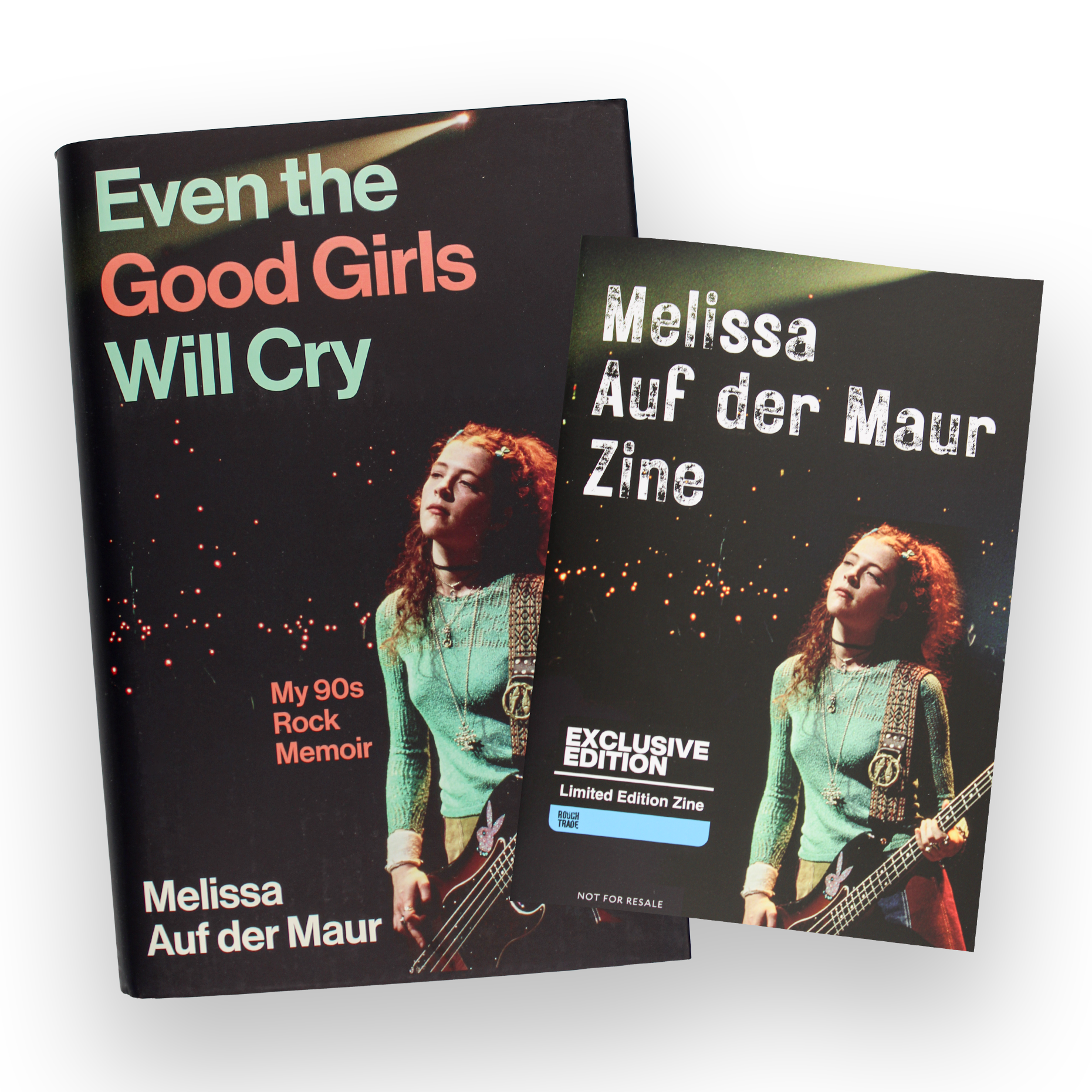
Get Melissa Auf der Maur's memoir Even the Good Girls Will Cry Rough Trade Book of the Year edition, with a signed bespoke bookplate + Rough Trade Exclusive zine including extra material.